
Accreditation & Law

Institutional Level

ASIC UK

Institutional Level

HEAD Germany

Institutional Level

ISO 21001:2018

Swiss Federal Member

SVEB

Ofqual UK.Gov Awarding Body

OTHM

Ofqual UK.Gov Awarding Body

QUALIFI

SwissUK™ Higher Education Institute

01

SwissUK™ Higher Education Institute in Zug, Switzerland, uniting Swiss excellence with UK-Government recognition.

02

For certain Swiss Triple Crown programs, SIMI grants recognition to the academic achievements from partner institutions.

03

All qualifications awarded by SIMI Swiss combine a Swiss Private Degree with a UK Government-recognized qualification; SIMI does not issue single degrees.

04

Businesses and countries highly value and recognize SIMI Swiss’s dual-degree system, where Swiss private excellence meets UK-Gov recognition.

The C.A.T.S for Smart University Strategy

C
Contents
*Course material is updated for current trends and needs, and is adaptable for all learners, including those with disabilities.
A
Accreditation
*Increase and expand accreditation where possible to enhance the quality and recognition of SIMI's programs and opportunities for continuous improvement.
T
Technology
*Integrate technology throughout the entire process from enrollment and training to administration, aiming for a paperless and borderless university.
S
Services
*Implement all activities with a spirit of service towards students, partners, and stakeholders, and ensure transparency of all information at every stage with involved parties.

Swiss Law on Higher Education

Swiss Higher Education System

The Swiss higher education system operates without a centralized educational authority; there is no single Ministry of Education overseeing the entire nation's educational framework. Instead, education in Switzerland is primarily managed at the cantonal (state) level, involving both public and private educational institutions that adhere to principles of autonomy and competition.

1. Diversity of Higher Education Institutions

While higher education in Switzerland is primarily dispensed by public institutions, there are also many private ones. Some of these private institutions cater primarily to Swiss clients. As such, they are part of Switzerland's public higher education sector and therefore receive public subsidies. Other private institutions were created mainly for the purpose of servicing international students and are not part of Switzerland's public higher education sector. Between these two extremes, there are situations that combine both realities and in some cases the same institution may even offer separate curricula to address the needs of both the Swiss and international markets.

2. High Degree of Autonomy and Oversight Mechanisms

As a general rule, in Switzerland no prior authorisation is required in order to offer higher education courses, organise examinations or issue private degrees. In certain cases, however, the federal or cantonal authorities, depending on their respective area of authority, will supervise private institutions and/or authorise them to offer courses and issue degrees. This supervision means that private institutions are required to accept a certain amount of public control. They must undergo quality inspections if they wish to issue protected titles that will be recognised as such. Non protected titles are nevertheless common.

3. Private Higher Education and Quality Assessment Mechanisms

Private higher education institutions that are not part of Switzerland's public education system, are not fully supervised by public authorities, or are classified as higher education institutes or schools of higher education do not necessarily offer lower-quality education. In fact, many reputable private institutions in Switzerland operate entirely independently from the public sector while maintaining high teaching standards. Swiss educational tradition emphasizes the role of the labor market and learners in assessing the quality of higher education institutions rather than relying on state intervention.

Conclusion:

The Swiss higher education system operates based on principles of autonomy, competition, and flexibility, allowing both public and private institutions to coexist without centralized control from a single Ministry of Education. Instead of being strictly regulated by the state, educational institutions—particularly private higher education institutes and schools—are evaluated by the market and learners based on the actual quality of their programs and the value of their degrees. The absence of centralized management and the limitation of state intervention promote competition, prevent protectionist mechanisms, and ensure fairness in the selection of educational programs. Switzerland upholds the right to self-determination and access to education for all citizens, fostering diversity and flexibility within its education system.

References:

Federal Department of Economic Affairs, Education and Research (EAER), State Secretariat for Education, Research and Innovation (SERI) Directorate: Validity of Degrees Issued by Private Higher Education Institutions in Switzerland – Office Circular.

Accreditation Regulations in Switzerland

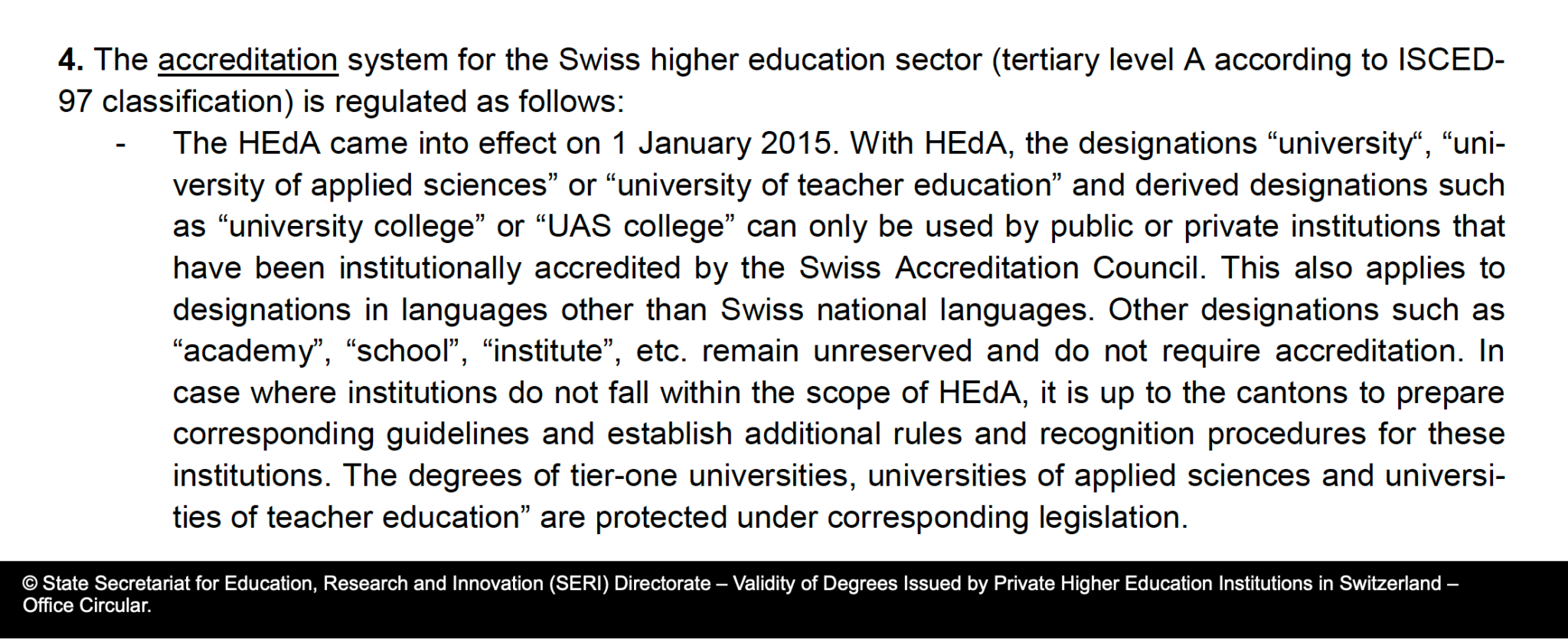
The accreditation system for Switzerland’s higher education sector (tertiary level according to the ISCED-97 classification) is regulated under the Federal Act on Funding and Coordination of the Higher Education Sector (HEdA, SR 414.20), which came into effect on January 1, 2015. According to this regulation:

  • With HEdA, designations such as "university," "university of applied sciences," "university of teacher education," and derived designations such as "university college" or "UAS college" can only be used by public or private institutions that have been institutionally accredited by the Swiss Accreditation Council. This regulation also applies to designations in languages other than Switzerland’s national languages.
  • Other designations such as “academy”, “school”, “institute”, etc. remain unreserved and do not require accreditation.
  • In case where institutions do not fall within the scope of HEdA, it is up to the cantons to prepare corresponding guidelines and establish additional rules and recognition procedures for these institutions.

References:
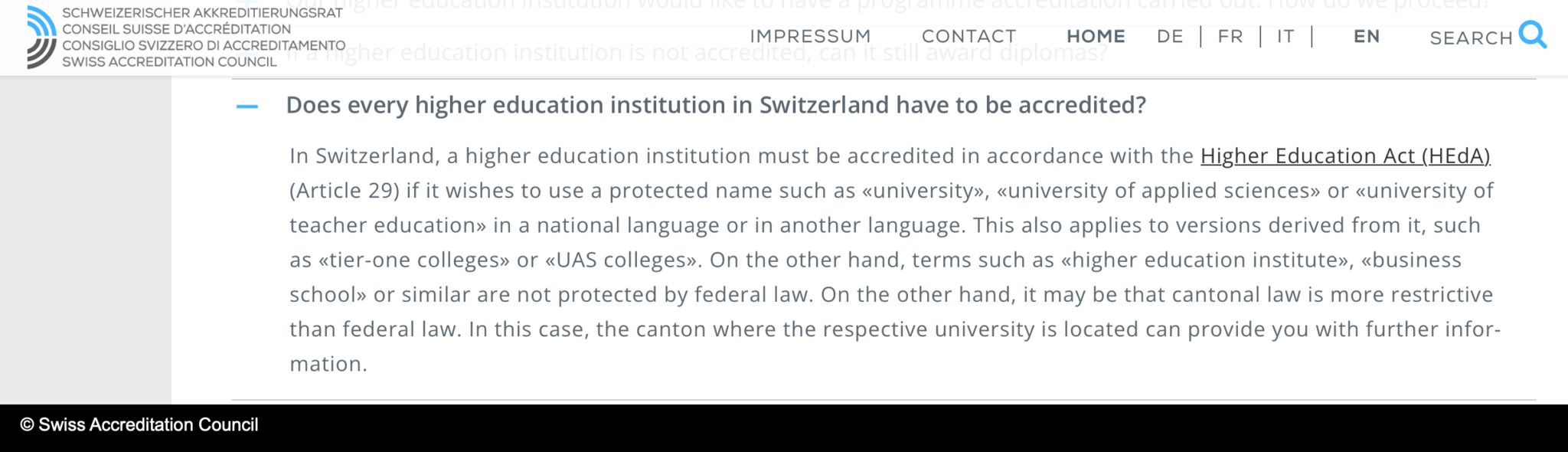
Question: Does every higher education institution in Switzerland have to be accredited?

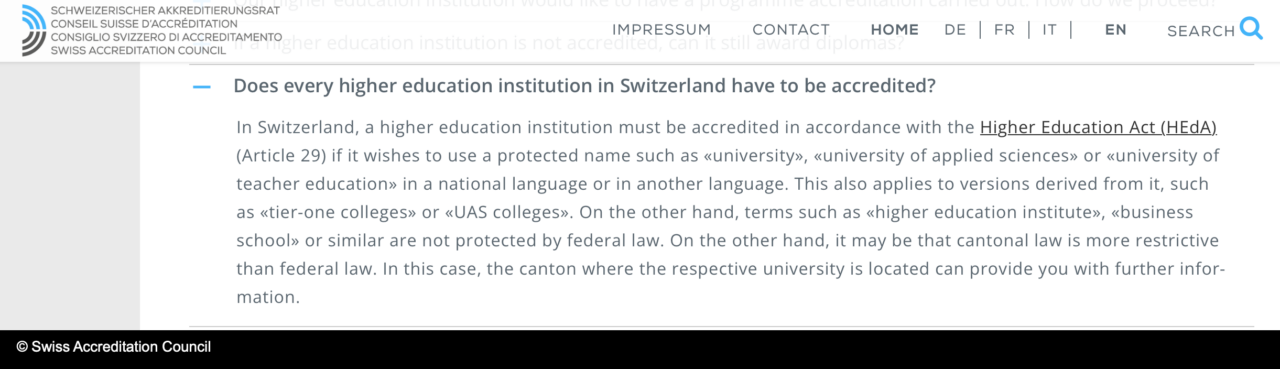
In Switzerland, a higher education institution must be accredited in accordance with the Higher Education Act (HEdA) (Article 29) if it wishes to use a protected name such as «university», «university of applied sciences» or «university of teacher education» in a national language or in another language. This also applies to versions derived from it, such as «tier-one colleges» or «UAS colleges». On the other hand, terms such as «higher education institute», «business school» or similar are not protected by federal law. On the other hand, it may be that cantonal law is more restrictive than federal law. In this case, the canton where the respective university is located can provide you with further information.


Source: Swiss Accreditation Council; excerpt from the FAQ section [See more]
    

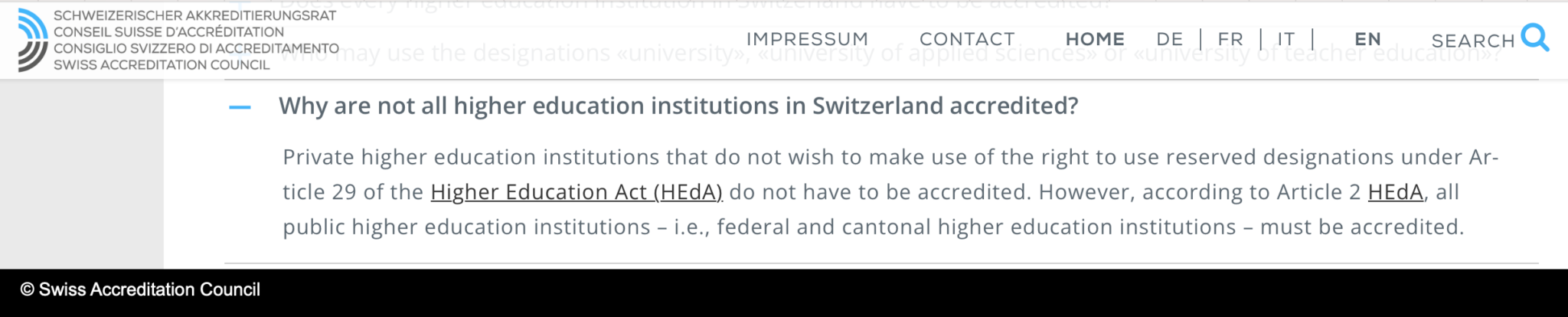
Question: Why are not all higher education institutions in Switzerland accredited?

Private higher education institutions that do not wish to make use of the right to use reserved designations under Article 29 of the Higher Education Act (HEdA) do not have to be accredited. However, according to Article 2 HEdA, all public higher education institutions – i.e., federal and cantonal higher education institutions – must be accredited.


Source: Swiss Accreditation Council; excerpt from the FAQ section [See more]
Question: What is the value of institutional accreditation for higher education graduates in terms of acceptance in the professional world and admission to other higher education institutions at national and international level?

Accreditation is not directly related to the acceptance of graduates in the world of work. However, accreditation plays a greater role in admission to other national and international higher education institutions.


Source: Swiss Accreditation Council; excerpt from the FAQ section [See more]

Question: I want to study at an institution that is not institutionally accredited – should I assume that it is of poor quality?

No, this conclusion cannot be drawn in this way.


Source: Swiss Accreditation Council; excerpt from the FAQ section [See more]

Principles of Qualification Recognition by the Swiss Government

As far as recognition of Swiss HEI qualifications are concerned:
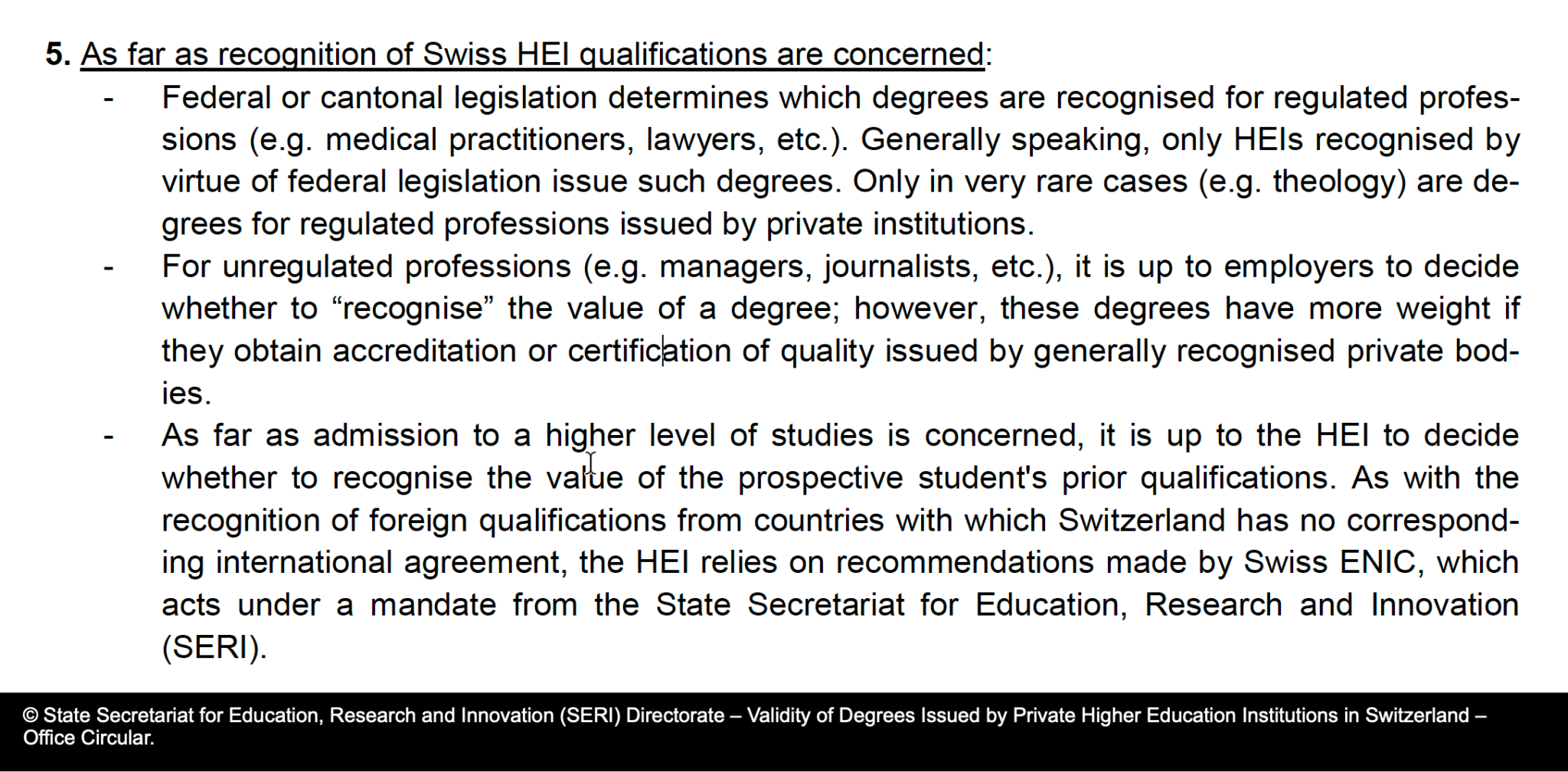
  • Federal or cantonal legislation determines which degrees are recognised for regulated professions (e.g. medical practitioners, lawyers, etc.). Generally speaking, only HEIs recognised by virtue of federal legislation issue such degrees. Only in very rare cases (e.g. theology) are degrees for regulated professions issued by private institutions.
  • For unregulated professions (e.g. managers, journalists, etc.), it is up to employers to decide whether to “recognise” the value of a degree; however, these degrees have more weight if they obtain accreditation or certification of quality issued by generally recognised private bodies.
  • As far as admission to a higher level of studies is concerned, it is up to the HEI to decide whether to recognise the value of the prospective student's prior qualifications. As with the recognition of foreign qualifications from countries with which Switzerland has no corresponding international agreement, the HEI relies on recommendations made by Swiss ENIC, which acts under a mandate from the State Secretariat for Education, Research and Innovation (SERI)
References:
Validity and Recognition of Private Degrees

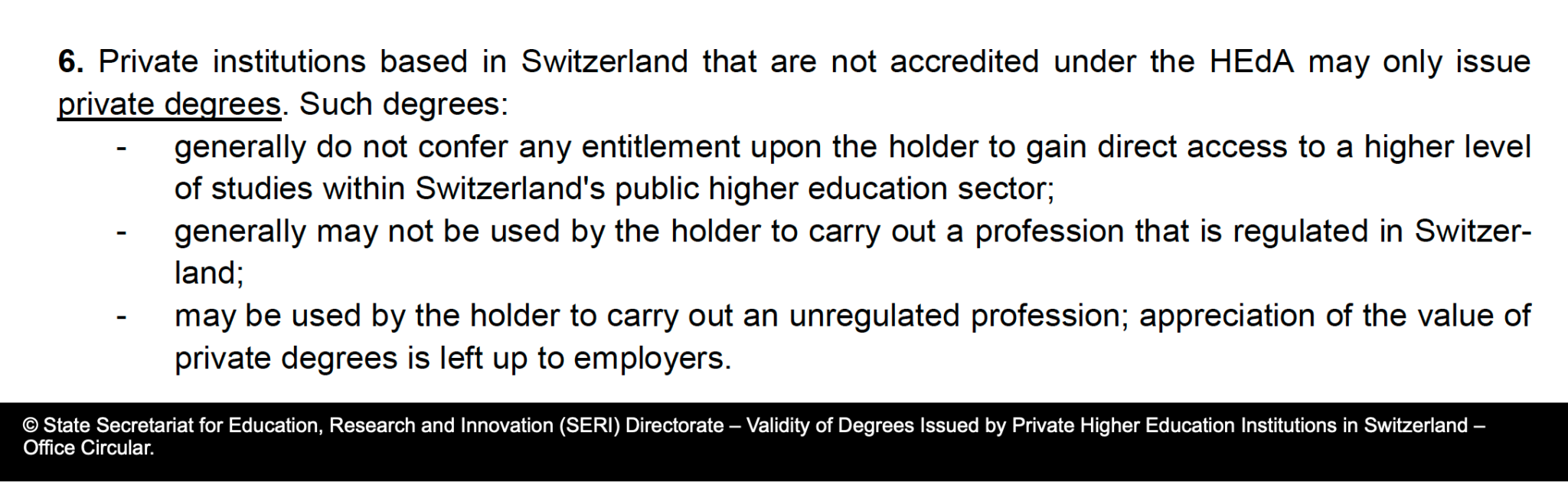
Private institutions based in Switzerland that are not accredited under the HEdA may only issue private degrees. Such degrees:

  • generally do not confer any entitlement upon the holder to gain direct access to a higher level of studies within Switzerland's public higher education sector; (Regarding admission to higher education levels, higher education institutions have full authority to decide on the recognition of the value of an applicant's previous qualifications).
  • generally may not be used by the holder to carry out a profession that is regulated in Switzerland. For this group of disciplines, private institutions typically do not offer training or issue degrees; (SIMI, as a private higher education institution in Switzerland, does not offer programs in this category.)
  • may be used by the holder to carry out an unregulated profession; appreciation of the value of private degrees is left up to employers.
References:
How to Identify and Differentiate Between Regulated and Non-Regulated Professions in Switzerland?

In Switzerland, professions can be broadly classified into regulated and non-regulated professions. Understanding the difference between these two groups is crucial for both Swiss citizens and international professionals intending to work in Switzerland.

Regulated Professions (Require Licensing & Certification)
Definition:

Regulated professions are those that require specific degrees and certifications as mandated by law to practice. These professions are typically supervised by professional bodies or government authorities.

Examples:
  • Healthcare: Doctors, nurses, pharmacists, and other medical professionals must meet strict educational and certification requirements.
    Law: Lawyers and notaries must be recognized by the bar association and meet specific education criteria.
  • Engineering & Architecture: Some engineering and architectural fields require certification from recognized professional bodies.
  • Finance: Certain financial roles, such as auditors and accountants, may require certification from accredited institutions.
Requirements:
  • Degree: A specific academic qualification, vocational training, and, in some cases, additional exams.
  • Certification: Registration with a professional body and compliance with continuous professional development requirements.
  • License: An official practice license, often requiring periodic renewal.
Non-Regulated Professions (No Licensing Required)
Definition:

Non-regulated professions do not require specific legal recognition or a professional license to practice.

Examples:
  • Management: Roles such as CEOs, HR Directors, and Business Managers.
  • Journalism: Reporters and media professionals.
  • Information Technology: Software developers, IT consultants, and network administrators.
  • Marketing & Sales: Marketing specialists, sales representatives, and business development experts.
  • Creative Industries: Graphic designers, artists, writers, and media professionals.
  • Hospitality & Tourism: Hotel managers, tour operators, and restaurant managers.
Requirements:
  • Degree & Certification: While not legally required, relevant degrees and professional certifications can improve job prospects.
  • Experience: Practical experience and a strong portfolio are often valued by employers.
  • Skills: Industry-specific skills and competencies are essential for career success.
Key Differences:
Legal Requirements:
  • Regulated Professions: Require specific degrees and certifications as mandated by law.
  • Non-Regulated Professions: No legal restrictions, but degrees can enhance employment opportunities.
Supervision:
  • Regulated Professions: Overseen by professional bodies and government authorities.
  • Non-Regulated Professions: No formal supervision, but industry standards and employer preferences apply.
Mobility and Recognition:
  • Regulated Professions: Foreign degrees may require assessment and equivalency recognition.
  • Non-Regulated Professions: More flexibility, as degrees and experience are often transferable.

SIMI Swiss Programs for Non-Regulated Professions

  • SIMI Swiss is a private higher education institution located in Zug, Switzerland. It offers single-degree programs (degrees solely awarded by SIMI) in non-regulated professions.
  • These programs allow graduates to work in various fields, including management roles such as CEO, HR Director, and Principal (Head of an educational institution).
SIMI Swiss Programs for Regulated Professions (If Applicable)

SIMI Swiss only provides programs for regulated professions through partnerships with other universities.

Through dual-degree programs and mutual recognition agreements with partner universities, students earn a dual degree. With the second degree from the partner university, students may enhance their eligibility for regulated professions (if required).

Reference:

How to Verify Whether a Profession Requires a License or Additional Certification Before Practicing in Switzerland?

To determine whether a profession requires a license or additional certification before practicing in Switzerland, follow these steps:

1. Check with Federal Authorities

  • Visit the website of the State Secretariat for Education, Research, and Innovation (SERI), which provides information on the recognition of foreign qualifications and regulated professions in Switzerland.
  • Website: SERI Official Site

2. Identify Whether the Profession is Regulated

  • Regulated professions require specific degrees or licenses to practice, such as those in healthcare, law, specialized teaching (early childhood, special education), or engineering.
  • Non-regulated professions may not require formal recognition but can be subject to industry-specific standards.

3. Consult the Professional Registers

Certain professions have specialized regulatory bodies or professional registers in Switzerland. Examples include:

  • Doctors: Swiss Medical Association (FMH)
  • Architects: REG A and REG B Registers
  • Teachers: Swiss Conference of Cantonal Ministers of Education (EDK)

4. Contact Cantonal Authorities

  • Licensing requirements may vary by canton in Switzerland. Contact the relevant cantonal office to confirm specific requirements for your profession.

5. Consider International Degree Recognition

  • If you have a foreign degree, check whether it is recognized in Switzerland. SERI provides detailed guidance on the recognition process and required steps.

6. Seek Professional Advice

  • For complex cases, consider consulting a lawyer or career advisor specializing in Swiss labor law and professional licensing.

This video offers a better understanding of professions and industries requiring additional licensing to work in Switzerland [HERE]

Accreditation and the positioning of SIMI as a SwissUK™ Higher Education Institution

The nature of SIMI - SwissUK™ HEI

Swiss Information and Management Institute (SIMI), operating as the SwissUK™ Higher Education Institution(hereinafter referred to as “SIMI – SwissUK™ HEI”), is a private, internationally oriented higher education institution established in Zug, Switzerland. SIMI – SwissUK™ HEI operates under an integrated academic model that combines the strengths of Swiss private higher education with the national qualification recognition framework of the United Kingdom.


The SwissUK™ model implemented by SIMI – SwissUK™ HEI is designed to integrate two complementary systems in a coherent and structured manner. On the one hand, it applies the academic standards, pedagogical approach, assessment rigor, and quality culture characteristic of Swiss private higher education. On the other hand, it incorporates qualification recognition mechanisms aligned with the United Kingdom’s nationally regulated framework, administered by the UK Government and regulated by Ofqual.


This integrated approach enables SIMI – SwissUK™ HEI to address both academic quality and international usability of qualifications. Learners are provided with access to Swiss private higher education standards while simultaneously benefiting from the portability, transparency, and international referencing of UK-regulated qualifications. The integration of these two systems is intended to enhance academic coherence, reduce regulatory fragmentation, and support cross-border educational and professional mobility.


SIMI – SwissUK™ HEI is positioned as a Switzerland Truly International™ Higher Education Institution and does not operate as a local or domestic higher education provider. Its programmes are developed for international learners and global labour markets and are not designed to serve national public education systems. Accordingly, SIMI – SwissUK™ HEI does not award single qualifications. Academic programmes are structured to lead to dual academic outcomes, which may include:
(i) a Swiss Private Degree or academic award reflecting Swiss private higher education standards; and
(ii) a qualification awarded or recognised within the United Kingdom’s national qualifications framework, subject to the rules and independent decision-making processes of the relevant awarding bodies.


As a private international higher education institution, SIMI – SwissUK™ HEI is not part of the Swiss public higher education system and does not fall within the scope of the Federal Act of 30 September 2011 on the Funding and Coordination of the Higher Education Sector (HEdA), SR 414.11.


Through the SwissUK™ integrated model, SIMI – SwissUK™ HEI operates as a cross-border academic platform that aligns Swiss academic excellence with UK qualification recognition structures, while maintaining institutional independence, regulatory transparency, and compliance with applicable international higher education norms.


All accreditation & Recognition of SIMI - SwissUK™ HEI click HERE

What accreditations does SIMI - SwissUK™ HEI have?

Although accreditation in Switzerland is optional and not legally mandatory, SIMI – SwissUK™ Higher Education Institution (SIMI – SwissUK™ HEI) is among the pioneering higher education institutions that have obtained accreditation at both the institutional and programmatic levels:


  • Accredited by the Accreditation Service for International Schools, Colleges and Universities (ASIC) at the highest level (Premier Institution); Read more [HERE]
  • A full member of SVEB (Swiss Federation for Adult Learning); Read more [HERE]
  • Accreditation of the management system as compatible with the European Quality Assurance Framework for Vocational Education and Training (EQAVET) and the Standards and Guidelines for Quality Assurance in the European Higher Education Area, awarded by the HEAD – Higher Education Accreditation Division; Read more [HERE]
  • Achievement of ISO 21001:2018 certification, demonstrating compliance with the European Quality Assurance Framework for Vocational Education and Training (EQAVET) and the Quality Assurance in the Higher Education Area Requirements (EGS); Read more [HERE]
  • Programs are recognised by Ofqual UK.Gov Awarding Bodies; OTHM Read more [HERE]; Qualifi Read more [HERE]
  • Learning outcomes are mapped to the United Kingdom’s National Occupational Standards. Read more [HERE]
 
Reference:
  • Guidelines on how to verify the accreditation status of SIMI – SwissUK™ Higher Education Institution (SIMI – SwissUK™ HEI): CLICK HERE

Why Does SIMI – SwissUK™ HEI Offer Dual Qualifications?

As SIMI – SwissUK™ Higher Education Institution (SIMI – SwissUK™ HEI) is positioned as a Switzerland Truly International™ Higher Education Institution, it does not award a single qualification. Instead, SIMI – SwissUK™ HEI operates a dual-award academic model that integrates a Swiss Private Degree with international accreditation and a nationally recognised qualification regulated by Ofqual (UK Government). This integrated structure enables learners to benefit from the following:

1. Dual Qualifications with Global Value

Learners are awarded two internationally relevant qualifications:

  • A Swiss Private Degree, demonstrating academic, research, and applied competence aligned with Swiss and European higher education standards; and
  • An Ofqual-regulated UK qualification, nationally recognised within the United Kingdom’s Regulated Qualifications Framework (RQF) and referenced internationally.

2. UK Government Recognition and International Employability

The UK qualification is regulated by Ofqual on behalf of the UK Government, ensuring nationally defined quality assurance standards and supporting academic and professional progression in the United Kingdom and internationally, subject to the regulations of receiving institutions and jurisdictions.

3. Integration of Two Complementary Education Systems

This distinctive academic structure combines the strengths of two leading systems:

  • The academic rigour, applied orientation, and quality tradition of Swiss private higher education; and
  • The transparency, national recognition, and international referencing of the UK qualifications framework.

Together, these elements deliver an education model that is academically robust and professionally relevant.

4. Enhanced International Recognition

Graduates benefit from qualifications that are widely understood by employers and academic institutions internationally.

  • UK-regulated qualifications are aligned with RQF levels, which may be relevant for Skilled Worker Visa considerations, subject to applicable immigration rules.
  • Qualifications may be referenced for comparability through established evaluation frameworks such as UK ENIC, WES, or NARIC, subject to independent assessment.

5. Flexible Delivery Aligned with International Standards

Programmes are designed in reference to European (ECTS/EQF) and UK (RQF) frameworks, supporting flexible study pathways through online, blended, or live-class delivery models, while maintaining internationally benchmarked academic standards.

6. Multi-Layered Quality Assurance Framework

Assessment and academic outcomes are subject to a structured quality assurance process, which may include:

  1. Internal Quality Assurance (IQA) conducted by SIMI – SwissUK™ HEI;
  2. External Quality Assurance (EQA) conducted by the relevant Ofqual-regulated awarding body;
  3. Oversight through independent international accreditation mechanisms, where applicable.

This framework supports transparency, consistency, and academic integrity across programmes.

7. Academic and Research Progression Opportunities

Subject to meeting entry requirements and the policies of receiving institutions, learners may progress to higher-level academic pathways such as MBA, MSc, DBA, or PhD programmes at public or private universities internationally, supported by academic alignment between the Swiss and UK systems.

Swiss–UK Agreement on the Mutual Recognition of Professional Qualifications

The Agreement between the Swiss Confederation and the United Kingdom of Great Britain and Northern Ireland on the Mutual Recognition of Professional Qualifications is a bilateral international treaty establishing a legal framework under which professional qualifications obtained in one country may be assessed and recognised in the other, subject to sector-specific rules, competent authorities, and applicable national legislation.


While this Agreement applies exclusively at the intergovernmental and regulatory level, it reflects a broader legal and policy context in which qualification comparability, professional mobility, and cross-border transparency are formally recognised objectives between Switzerland and the United Kingdom.


Within this international context, the SwissUK™ model implemented by SIMI – SwissUK™ Higher Education Institution (SIMI – SwissUK™ HEI) is designed to align academic learning outcomes with internationally referenced frameworks commonly used in both jurisdictions. For learners, this alignment may provide practical advantages in terms of readability, comparability, and professional interpretation of qualifications when engaging with employers, professional bodies, or academic institutions in international environments.


This approach does not constitute automatic or guaranteed recognition under the Swiss–UK Agreement, nor does it imply that SIMI – SwissUK™ HEI operates under, implements, or derives authority from the Agreement. Any reference to the Agreement is made solely for contextual and explanatory purposes.


All decisions regarding the recognition, acceptance, or use of qualifications remain subject to the independent authority of the relevant competent bodies, receiving institutions, employers, or regulators, in accordance with the applicable laws and regulations of each jurisdiction.


Read more HERE

If quality accreditation is not mandatory, why does SIMI – SwissUK™ HEI voluntarily pursue accreditation?

Although quality accreditation is not mandatory and does not legally apply in the case of SIMI – SwissUK™ Higher Education Institution (SIMI – SwissUK™ HEI), SIMI – SwissUK™ HEI does not regard accreditation as a marketing or image-building exercise. Instead, SIMI – SwissUK™ HEI views accreditation as a structured mechanism for continuous quality enhancement, supporting the delivery of academically robust programmes and enabling learners to access education aligned with international standards.

View all accreditations of SIMI – SwissUK™ Higher Education Institution (SIMI – SwissUK™ HEI) here.

If quality accreditation is not mandatory, why does SIMI – SwissUK™ HEI plan to pursue accreditation from the Swiss Accreditation Council and the Agency of Accreditation and Quality Assurance?

SIMI – SwissUK™ Higher Education Institution (SIMI – SwissUK™ HEI) aims to progress towards the status of a University of Applied Sciences in Switzerland and intends to participate in regulated professional sectors, including medical and nursing fields. This strategic direction represents an important step in strengthening institutional governance, enhancing quality assurance, and supporting continuous improvement of academic outcomes.

See more about the plan to become a Swiss University of Applied Sciences with Federal status [HERE]

Training Model and Legal Compliance

Full-Time Study in Switzerland

Students enrolled in the full-time programme study at the Swiss campus of SIMI – SwissUK™ Higher Education Institution (SIMI – SwissUK™ HEI) and its partner institutions in Zug and other cantons across Switzerland.


In addition to on-campus instruction, students may receive German language training, develop workplace-related skills, and, subject to meeting the applicable German and/or French language requirements, may have the opportunity to participate in an internship programme in Switzerland.

Full-Time Study at the Asia Campus

SIMI – SwissUK™ Higher Education Institution (SIMI – SwissUK™ HEI) collaborates with partner universities in Asia to offer full-time study programmes delivered at designated regional campuses.


Under this arrangement, students attend classes directly at the partner university. SIMI – SwissUK™ HEI may conduct an academic quality review and, subject to internal assessment procedures and the receipt of official academic confirmation from the partner institution, may provide joint academic recognition of learning outcomes, where applicable.


All matters relating to travel, accommodation, local student services, and on-site support are managed and provided by the respective regional partner, in accordance with local regulations and institutional arrangements.

Online Learning Model

SIMI – SwissUK™ Higher Education Institution (SIMI – SwissUK™ HEI) offers online learning programmes for global learners who are unable to attend its physical campuses. To ensure academic quality, regulatory compliance across jurisdictions, and respect for learner choice and lifelong learning pathways, SIMI – SwissUK™ HEI implements an online delivery model based on the following principles:


Direct Academic Delivery
SIMI – SwissUK™ HEI delivers online programmes directly to enrolled students without the use of third-party training intermediaries.
Objective: To ensure students have direct access to the original curriculum and to maintain full institutional control over academic quality and programme delivery.


Limited Role of Local Partners
Local partners, where applicable, provide academic support services only. They do not participate in programme delivery, assessment, academic decision-making, or the determination of learning outcomes, all of which remain under the exclusive authority of SIMI – SwissUK™ HEI.
Objective: To preserve programme integrity and ensure that External Quality Assurance (EQA) processes are conducted independently, accurately, and transparently.


Under this model, students enrol and study directly with SIMI – SwissUK™ HEI, ensuring unrestricted access to the original academic programme, consistent application of quality standards, and reliable external quality assurance outcomes.

Transparency from the Start and Encouraging Students to Research Before Enrollment

To ensure transparency, SIMI – SwissUK™ Higher Education Institution (SIMI – SwissUK™ HEI) permits the translation of officially published content to facilitate access to complete and accurate information for learners. All relevant information is made publicly available through official communication channels and is further clarified during the initial consultation process.


Students are consistently provided with detailed programme and institutional information and remain responsible for reviewing, verifying, and understanding such information prior to enrolment.


SIMI – SwissUK™ HEI, together with its associated entities where applicable, clearly discloses roles, responsibilities, and applicable disclaimers in order to ensure transparency, prevent misunderstandings or intentional misinterpretations, and reduce the risk of inaccurate or misleading communications.


All published materials and communications with stakeholders adhere to the principles of clarity, transparency, and factual accuracy and do not constitute, nor imply, any commitment or representation beyond the lawful authority and institutional remit of SIMI – SwissUK™ HEI.

Disclaimer

SIMI (Swiss Information and Management Institute) – SwissUK™ Higher Education Institution (SIMI – SwissUK™ HEI), together with its partners and local academic collaborators (hereinafter collectively referred to as “We”), is committed to transparency, the prevention of misunderstandings or intentional misinterpretations, and the protection of the lawful rights and interests of students.


Applicants enrolling in any programme are responsible for independently and thoroughly reviewing all relevant information, in particular information relating to their personal learning objectives, intended use of qualifications after graduation, and any academic, professional, or regulatory implications thereof.


In order to ensure transparency, clarify the respective rights and obligations of all parties, and expressly address matters involving third parties that fall outside our control, influence, or authority to guarantee, SIMI – SwissUK™ HEIhereby issues the following disclaimer policy:


  1. No Guarantee of Graduation or Award
    Enrolment in a programme does not constitute a guarantee of programme completion, graduation, qualification attainment, or degree issuance. Partner universities award qualifications and recognise academic outcomes solely where students fully satisfy all applicable academic requirements, financial obligations, study discipline standards, and institutional regulations.

  2. Right to Refuse or Terminate Student Status
    In cases including, but not limited to, unauthorised absences, voluntary withdrawal from a programme, academic misconduct, or failure to meet financial obligations, SIMI – SwissUK™ HEI reserves the right to refuse admission, withhold academic or administrative support, revoke student status, and decline any refund of tuition fees or associated costs, in accordance with applicable policies.

  3. No Guarantee of Third-Party Recognition
    SIMI – SwissUK™ HEI does not guarantee that any degree, qualification, certificate, transcript, or academic result will be accepted, recognised, accredited, or deemed equivalent by any third party, including but not limited to government authorities, local administrations, professional bodies, employers, or other educational institutions. All such decisions remain at the sole discretion of the receiving entity and are governed by the laws and regulations of the relevant jurisdiction.

  4. No Guarantee of Career or Financial Outcomes
    SIMI – SwissUK™ HEI does not guarantee salary increases, promotions, career advancement, employment placement, or any specific professional outcome following graduation.

  5. No Guarantee of Qualification Recognition and Equivalence
    While various national and international frameworks for qualification recognition and equivalence exist, each country, organisation, or institution retains independent authority to assess and recognise qualifications. SIMI – SwissUK™ HEI does not guarantee, commit to, or promise the recognition or equivalence of any academic documents issued by itself or its partners, nor does it guarantee or facilitate any equivalency recognition process.

  6. No Guarantee of Immigration, Employment, or Professional Rights
    SIMI – SwissUK™ HEI does not guarantee residency rights, employment opportunities abroad, work permits, teaching licences, professional registrations, or any similar authorisations in Switzerland, Europe, or any other jurisdiction.

  7. No Guarantee of Visa Approval
    SIMI – SwissUK™ HEI does not guarantee the granting of any student visa or other type of visa, where applicable. Visa issuance or refusal is solely determined by the competent authorities of the relevant country and lies entirely outside the control of SIMI – SwissUK™ HEI.

FAQs for Accreditation (Government Information)

What is the value of institutional accreditation for higher education graduates in terms of acceptance in the professional world and admission to other higher education institutions at national and international level?

Accreditation is not directly related to the acceptance of graduates in the world of work. However, accreditation plays a greater role in admission to other national and international higher education institutions.

Source: Swiss Accreditation Council; extracted from the FAQ section, from the question, “What is the value of institutional accreditation for higher education graduates in terms of acceptance in the professional world and admission to other higher education institutions at national and international levels?” Read more here.

I want to study at an institution that is not institutionally accredited – should I assume that it is of poor quality?

No, this conclusion cannot be drawn in this way.

Source: Swiss Accreditation Council; extracted from the FAQ section, from the question, “I want to study at an institution that is not institutionally accredited – should I assume that it is of poor quality?” Read more here.

If a higher education institution is not accredited, can it still award diplomas?

In principle, yes, but the laws of the siting cantons must be observed, as the awarding of titles is the responsibility of the cantons. The right of a higher education institution to award titles is also not tied to accreditation.

Source: Swiss Accreditation Council; extracted from the FAQ section, from the question, “If a higher education institution is not accredited, can it still award diplomas?” Read more here.

Does every higher education institution in Switzerland have to be accredited?

Not all HEI in Switzerland have to accredited.

In Switzerland, a higher education institution must be accredited in accordance with the Higher Education Act (HEdA)(Article 29) if it wishes to use a protected name such as «university», «university of applied sciences» or «university of teacher education» in a national language or in another language. This also applies to versions derived from it, such as «tier-one colleges» or «UAS colleges». On the other hand, terms such as «higher education institute», «business school» or similar are not protected by federal law. On the other hand, it may be that cantonal law is more restrictive than federal law. In this case, the canton where the respective university is located can provide you with further information.

Source: Swiss Accreditation Council; extracted from the FAQ section, from the question, “Does every higher education institution in Switzerland have to be accredited?” Read more here.
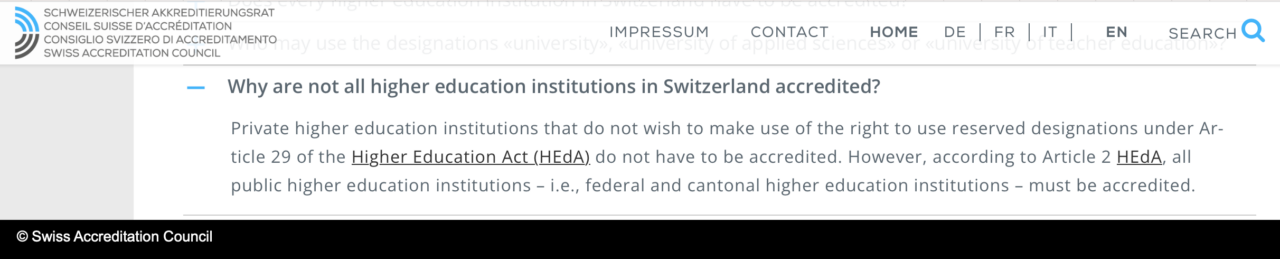
Why are not all higher education institutions in Switzerland accredited?

Private higher education institutions that do not wish to make use of the right to use reserved designations under Article 29 of the Higher Education Act (HEdA) do not have to be accredited. However, according to Article 2 HEdA, all public higher education institutions – i.e., federal and cantonal higher education institutions – must be accredited.

Source: Swiss Accreditation Council; extracted from the FAQ section, from the question, “Why are not all higher education institutions in Switzerland accredited?” Read more here.
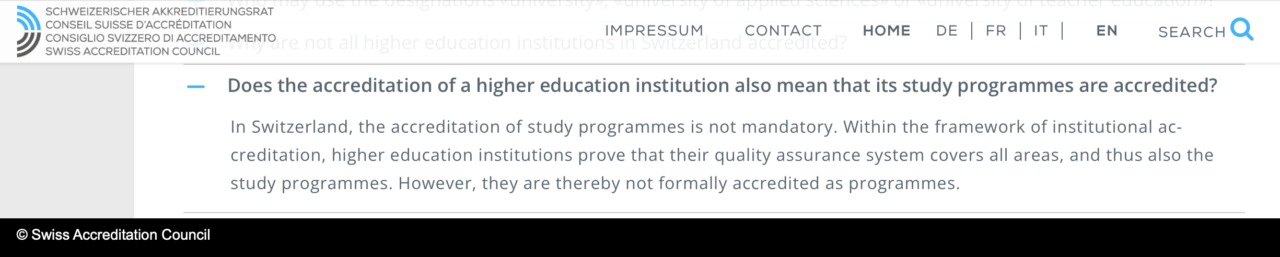
Does the accreditation of a higher education institution also mean that its study programmes are accredited?

In Switzerland, the accreditation of study programmes is not mandatory. Within the framework of institutional accreditation, higher education institutions prove that their quality assurance system covers all areas, and thus also the study programmes. However, they are thereby not formally accredited as programmes.

Source: Swiss Accreditation Council; extracted from the FAQ section, from the question, “Does the accreditation of a higher education institution also mean that its study programmes are accredited?” Read more here.
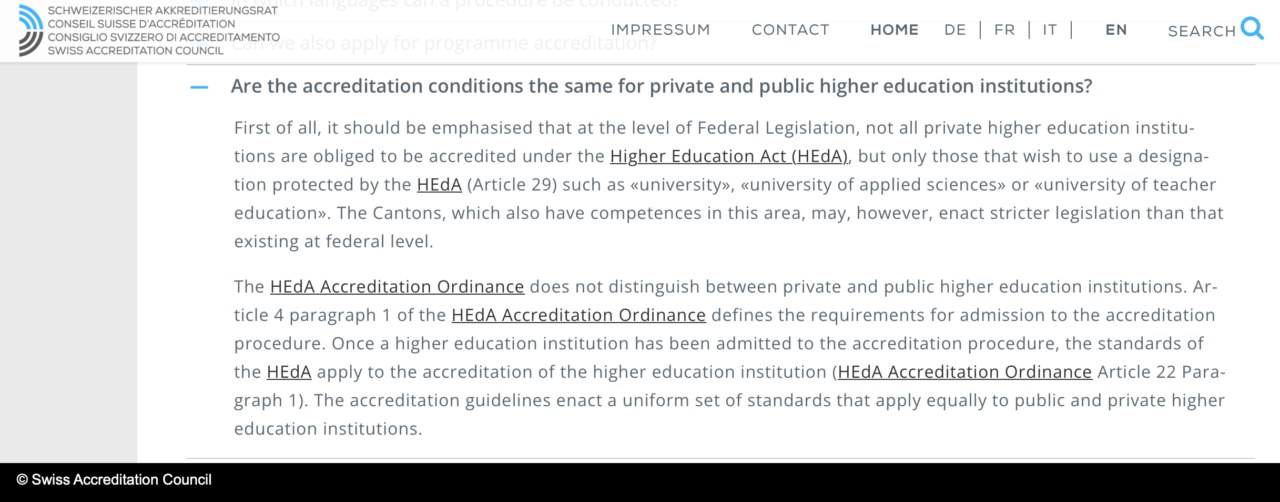
Are the accreditation conditions the same for private and public higher education institutions?

First of all, it should be emphasised that at the level of Federal Legislation, not all private higher education institutions are obliged to be accredited under the Higher Education Act (HEdA), but only those that wish to use a designation protected by the HEdA (Article 29) such as «university», «university of applied sciences» or «university of teacher education». The Cantons, which also have competences in this area, may, however, enact stricter legislation than that existing at federal level.

The HEdA Accreditation Ordinance does not distinguish between private and public higher education institutions. Article 4 paragraph 1 of the HEdA Accreditation Ordinance defines the requirements for admission to the accreditation procedure. Once a higher education institution has been admitted to the accreditation procedure, the standards of the HEdA apply to the accreditation of the higher education institution (HEdA Accreditation Ordinance Article 22 Paragraph 1). The accreditation guidelines enact a uniform set of standards that apply equally to public and private higher education institutions.

Source: Swiss Accreditation Council; extracted from the FAQ section, from the question, “Are the accreditation conditions the same for private and public higher education institutions?” Read more here.
Quality accreditation is not mandatory and does not apply to SIMI Swiss, so why does SIMI Swiss still pursue accreditation?

Although quality accreditation is not mandatory and does not apply in the case of SIMI Swiss, SIMI Swiss does not view accreditation as a marketing or image-building activity. Instead, SIMI Swiss sees accreditation as an opportunity for continuous quality improvement, helping students gain access to a world-class program.

View all of SIMI Swiss’s accreditations here.

Quality accreditation is not mandatory for SIMI Swiss, so why does SIMI Swiss plan to obtain accreditation from the Swiss Accreditation Council and the Agency of Accreditation and Quality Assurance?

SIMI Swiss aims to become a University of Applied Sciences in Switzerland and intends to join regulated professional sectors such as medical and nursing. This is an important step to help SIMI Swiss better control quality, outcomes, and opportunities for continuous improvement.

See more about the plan to become a Swiss University of Applied Sciences with Federal status [HERE]
FAQs for Recognition

What is the difference between accreditation and recognition?

The difference between accreditation and recognition lies in their purpose and function in the context of education:

Accreditation:
  1. Definition:
    Accreditation is a formal process where an independent authority evaluates and certifies that an institution or program meets specific quality standards. It ensures the institution provides education at an acceptable level of quality.
  2. Focus:
    Primarily focuses on quality assurance and adherence to established educational standards.
  3. Authority:
    Conducted by authorized accrediting agencies, often independent or government-approved, such as AACSB for business schools or regional accreditation bodies in the U.S.
  4. Scope:
    Applies to institutions or programs and verifies their legitimacy and standardization.
  5. Impact:
    Accreditation assures stakeholders (students, employers, etc.) that the institution or program meets high educational standards and allows access to financial aid, credit transfers, or further studies.
Recognition:
  1. Definition:
    Recognition refers to the acceptance or acknowledgment of an institution, program, or qualification by third parties, often for professional purposes. This is not always automatic and varies by country and field.
  2. Focus:
    Primarily focuses on acceptance of the qualification for further studies, employment, or other purposes.
  3. Authority:
    Determined by third parties and end users.
  4. Scope:
    Recognition does not necessarily evaluate quality but confirms that a degree or qualification is accepted within a specific industry.
  5. Impact:
    Recognition determines whether qualifications are valid for purposes like employment, licensing, or further education in a specific region or field.

In the context of private higher education, the recognition of qualifications from a Private Higher Education Institute is determined by the end user, as it is rooted in academic freedom and the autonomy of educational higher education institutions.

Summary of the Difference:
  • Accreditation ensures the quality and legitimacy of the educational offering.
  • Recognition determines whether the accredited qualification is accepted in a particular context or by a particular organization or government.
Example:
  • In the context of SIMI Swiss, higher education institutions are not mandatory to obtain accreditation in Switzerland after receiving a license but might seek recognition from a professional organization (for example OTHM, ATHE, Qualfi) in another country for their graduates to practice in that field.
  • Although not mandatory, to ensure quality, continuous improvement opportunities, and broader recognition in the workplace, the Swiss Information and Management Institute (SIMI Swiss) has achieved accreditation at both the institutional and program levels. The programs of SIMI Swiss are mapped and recognized by Ofqual UK.Gov Awarding Bodies, thereby maximizing the potential for qualifications from SIMI Swiss to be widely recognized in the workplace across most countries and territories. Read more [HERE]

Is recognition automatic?

No, recognition is not automatic. It often depends on specific factors and may require additional processes to ensure a qualification or institution is recognized in a particular country, organization, or industry. Below are key points to understand about recognition:

Factors Affecting Recognition:
  1. Accrediting Body:

    • If a program or institution is accredited by a globally or regionally reputable body, it has a higher chance of being recognized.
    • For example, qualifications aligned with frameworks like Ofqual (UK) or accredited by internationally respected bodies are more likely to be recognized.
  2. Jurisdictional Policies:

    • Each country or organization has its own policies for recognizing foreign qualifications. Recognition often requires alignment with local standards.
  3. Professional or Regulatory Requirements:

    • Some fields (e.g., medicine, law, engineering) require qualifications to meet professional licensing standards, which might involve additional verification, exams, or certifications.
  4. Mutual Recognition Agreements (MRAs):

    • Some countries have agreements to recognize each other's qualifications, which can simplify the process.
  5. Process of Recognition:

    • In many cases, individuals or institutions must apply for recognition by submitting documentation, such as transcripts, accreditation proof, or program mapping.
Key Takeaway:

Recognition is not automatic and often involves ensuring alignment with local, national, or professional standards. Accredited programs or qualifications mapped to international frameworks, like those of Ofqual UK, can streamline recognition processes but do not guarantee automatic acceptance.

Understanding this and recognizing that it is beyond the authority of SIMI Swiss, SIMI Swiss does not commit to this, as stated in all its documents and communicated to students, partners, and third parties

How can I verify if a diploma from SIMI Swiss is mapped to an Ofqual UK.Gov Awarding Body?

The Swiss Information and Management Institute (SIMI Swiss) have aligned their programs with UK awarding bodies regulated by Ofqual, such as OTHM and QUALIFI. This alignment allows students to receive dual qualifications: one from the Swiss institution and an additional diploma from the UK awarding body. According to Swiss law, a Private Degree, such as that of SIMI Swiss, can be used in the workplace, and its recognition is determined by the employer. Therefore, with the integration of Ofqual UK.Gov Awarding Body, the opportunities for dual-degree utilization are significantly expanded.

To verify SIMI Swiss's recognition by Ofqual UK.Gov Awarding Bodies (such as OTHM and Qualifi), you can check SIMI Swiss's accreditation status on the official portals of OTHM and Qualifi or review the proof of recognition provided by these bodies.

To verify the recognition of Ofqual UK.Gov Awarding Bodies, you can check the UK government's official portal. Since these qualifications are mapped to the Regulated Qualifications Framework (RQF), they are officially recognized within the UK and can enhance broader international recognition.

However, recognition of qualifications can vary by country and industry. It's advisable to consult with local professional bodies or employers in your target region to confirm acceptance.

In summary, while the mapping of SIMI Swiss and PIS programs with Ofqual-regulated awarding bodies enhances their recognition potential, it's important to verify acceptance with relevant authorities or organizations in the specific country or industry where you intend to use the qualification before enrollment.

How can one identify and distinguish between regulated and non-regulated professions in Switzerland?

In Switzerland, professions can be broadly categorized into regulated and non-regulated professions. Understanding the difference between these two categories is crucial for both Swiss citizens and international professionals aiming to work in Switzerland.

Regulated Professions:

Definition:
  • Regulated professions are those that require specific qualifications and certifications by law to practice. These professions are often subject to oversight by professional bodies or government agencies.
Examples:
  • Healthcare: Doctors, nurses, pharmacists, and other healthcare professionals must meet stringent educational and certification requirements.
  • Law: Lawyers and notaries must be admitted to the bar and fulfill specific educational criteria.
  • Engineering and Architecture: Certain engineering disciplines and architecture require accreditation from recognized professional bodies.
  • Finance: Some financial roles, such as auditors and accountants, may require certification from recognized institutions.
Requirements:
  • Qualifications: Specific academic degrees, professional training, and sometimes additional exams.
  • Certification: Registration with a professional body and compliance with ongoing professional development requirements.
  • Licensing: Official licenses to practice, often requiring renewal.

Non-Regulated Professions:

Definition:
  • Non-regulated professions do not have legal restrictions on who can practice. While qualifications can enhance employability, they are not legally mandated.
Examples:
  • Managers: Managers play a crucial role in the success and efficiency of organizations like CEO, HRM…
  • Journalists: Their roles are multifaceted and encompass various responsibilities that ensure the delivery of accurate, unbiased, and timely information
  • Information Technology: Roles such as software developers, IT consultants, and network administrators.
  • Marketing and Sales: Marketing specialists, sales representatives, and business development professionals.
  • Creative Industries: Graphic designers, artists, writers, and media professionals.
  • Hospitality and Tourism: Hotel management, tour operators, and restaurant management.
Requirements:
  • Qualifications: While not legally required, relevant academic degrees and professional certifications can improve job prospects.
  • Experience: Practical experience and a proven track record are often highly valued.
  • Skills: Specific skills and competencies relevant to the industry.

Key Differences:

Legal Requirements:

  • Regulated: Legally mandated qualifications and certifications.
  • Non-regulated: No legal restrictions, though qualifications can enhance employability.

Oversight:

  • Regulated: Subject to oversight by professional bodies and government agencies.
  • Non-regulated: No formal oversight, though industry standards and employer preferences apply.

Mobility and Recognition:

  • Regulated: International qualifications may require recognition and equivalence assessments.
  • Non-regulated: More flexibility, with qualifications and experience often being transferable.

Programs at SIMI Swiss lead to non-regulated professions:

  • As a private higher institute in Zug, Switzerland, SIMI Swiss offers single-degree programs (degrees awarded only by SIMI) in the field of non-regulated professions.
  • These non-regulated profession programs enable graduates to work in fields such as management, CEO, human resources director, and principal (director of an educational institution).

Programs of SIMI Swiss lead to regulated professions:

SIMI Swiss only offers programs leading to regulated professions in collaboration with another university.

Through the dual degree system and mutual recognition of results from partner universities, students receive dual degrees. With the second degree from the partner university, students can expand their eligibility for regulated professional fields (if required).

References:

How can one verify whether a profession requires additional licenses or certifications before being practiced in Switzerland?

To verify whether a profession requires additional licenses or certifications before being practiced in Switzerland, follow these steps:

  1. Check the Federal Authorities:
    • Visit the website of the State Secretariat for Education, Research, and Innovation (SERI), which provides information about the recognition of foreign qualifications and regulated professions in Switzerland.
    • Website: SERI Official Site
  2. Determine if the Profession is Regulated:
    • Regulated professions require specific qualifications or licenses to practice, such as in healthcare, law, teaching, or engineering.
    • Non-regulated professions may not require formal recognition but might have industry-specific standards.
  3. Consult the Professional Registry:
    • Some professions have dedicated regulatory bodies or registries in Switzerland. For example:
      • Doctors: Swiss Medical Association (FMH)
      • Architects: REG A and REG B registries
      • Teachers: Swiss Conference of Cantonal Ministers of Education (EDK)
  4. Contact Cantonal Authorities:
    • Requirements can vary by canton in Switzerland. Contact the relevant cantonal office to confirm any additional requirements for your profession.
  5. Review International Qualification Recognition:
    • If you hold foreign qualifications, check their eligibility for recognition in Switzerland. SERI provides detailed guidance on recognition processes and necessary steps.
  6. Seek Professional Advice:
    • For complex cases, you may consult a lawyer or career advisor specializing in Swiss labor laws and professional licensing.

Check out this video to help you understand which majors and fields require additional licenses to work in Switzerland [HERE].

Why do SIMI Swiss implement a Dual Qualification system?

SIMI Swiss is not a local higher education institution but an international one, and with its Swiss Truly International™ positioning, every program is designed for global students with the mission of offering more than one opportunity in the international job market.


For this reason, SIMI Swiss integrates programs and qualifications recognized by the UK Government, ensuring maximum benefit for learners.


This is not merely a dual-degree model, but a system that optimizes both recognition and competency: (1) a UK Government-recognized qualification that evidences professional ability, and (2) a Swiss private degree that reflects the prestige of Swiss education.


To further enhance employability, SIMI requires graduates to present both qualifications simultaneously, ensuring comprehensive recognition from employers.

Swiss University Federal Status 2027 Plan

    Contact Us

    Mapping

    2024

    Mapping SIMI QAQC systems with QAA standards

    Preparation

    2025

    Prepare necessary conditions and resources

    Self-evaluation

    2026

    Self-evaluation according to AAQ guidelines

    Self-evaluation

    2027

    Submit AAQ accreditation, recognized by the Swiss Accreditation Council

    SwissUK Higher Education Institute