

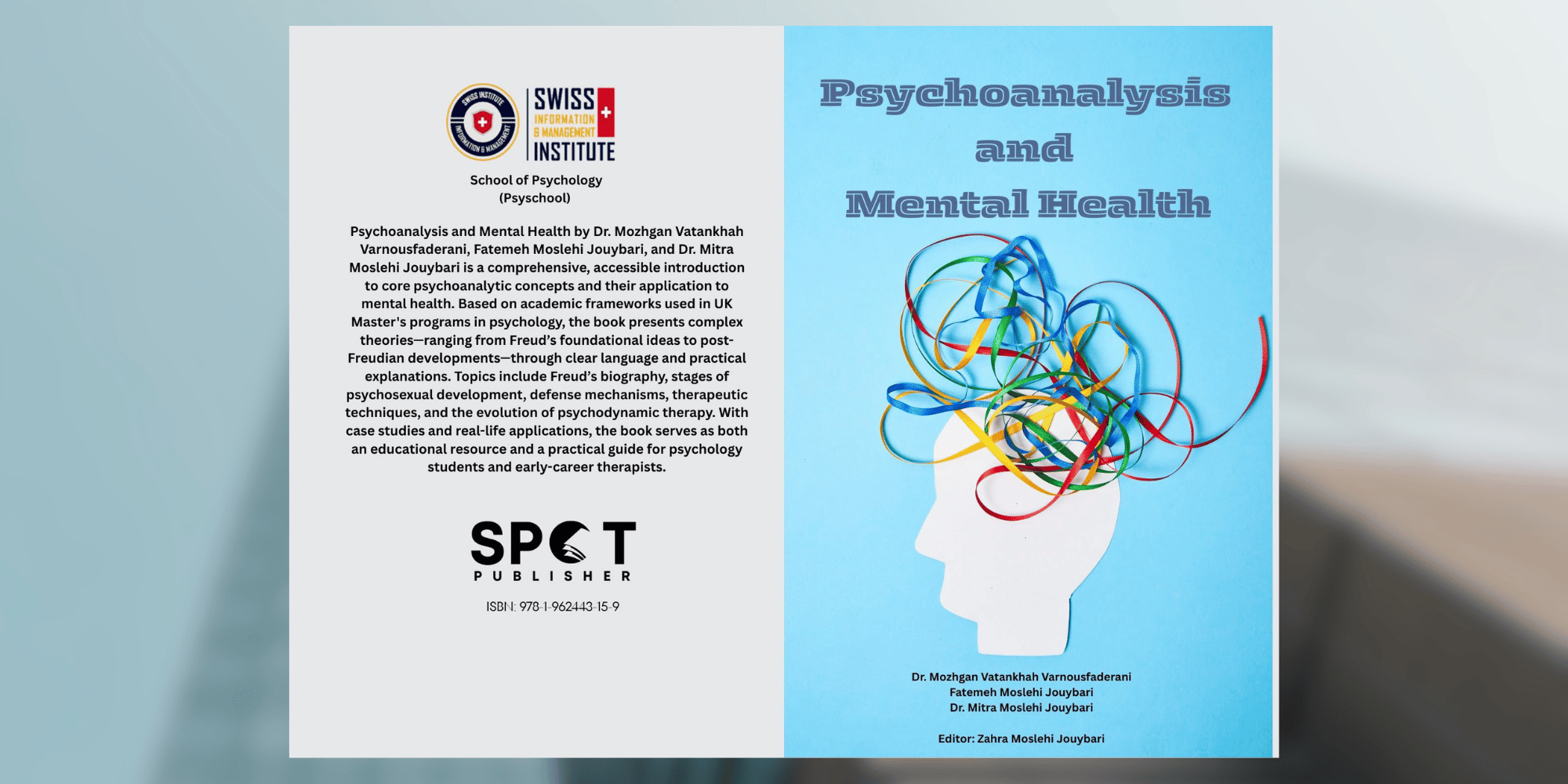
SIMI – Swiss Information and Management Institute – is proud to announce the publication of a new book by the SIMI School of Psychology (PsySchool)
In an era where mental health has become one of the most pressing global concerns, the need for accessible yet academically grounded resources is more important than ever. Psychoanalysis and Mental Health offers a thoughtful and practical exploration of psychoanalytic theory and its relevance to modern psychological practice, making complex ideas understandable for both emerging professionals and experienced practitioners.
Authored by Mozhgan Vatankhah Varnousfaderani, Fatemeh Moslehi Jouybari, and Mitra Moslehi Jouybari, this work provides readers with a structured journey through the foundations and evolution of psychoanalytic thinking. Drawing upon academic frameworks commonly used in UK Master’s level psychology programmes, the book transforms sophisticated theoretical concepts into clear, applicable knowledge.
A Comprehensive Introduction to Psychoanalytic Thought
Psychoanalysis has shaped modern psychology for more than a century, influencing how clinicians understand human behaviour, emotional development, and unconscious processes. This book revisits core psychoanalytic concepts beginning with Sigmund Freud’s foundational theories and continuing through contemporary psychodynamic perspectives.
Readers are guided through key areas such as:
- The historical development of psychoanalysis
- Freud’s theoretical contributions and legacy
- Psychosexual stages of development
- Defense mechanisms and unconscious processes
- Therapeutic relationships and intervention techniques
- The evolution of psychodynamic therapy in modern clinical contexts
Rather than presenting psychoanalysis as a purely historical framework, the authors demonstrate how these theories continue to inform current mental health practice.

Connecting Theory with Real-World Mental Health Practice
One of the strengths of Psychoanalysis and Mental Health lies in its practical orientation. Through case studies and applied examples, the book bridges the gap between abstract theory and real-life clinical situations. Readers are encouraged to think critically about how psychoanalytic ideas can be used to understand complex emotional experiences, personality development, and therapeutic dynamics.
This approach makes the book particularly valuable for:
- Psychology students at undergraduate and postgraduate levels
- Early-career therapists and counsellors
- Educators in psychology and mental health fields
- Professionals seeking a refresher on psychoanalytic foundations
The text supports both academic learning and professional reflection, offering insights that can be directly translated into therapeutic understanding.
An Accessible Academic Resource
Despite dealing with sophisticated psychological theories, the writing style remains clear and reader-friendly. The authors avoid unnecessary jargon while maintaining academic integrity, ensuring that readers from diverse backgrounds can engage meaningfully with the material.
This balance between accessibility and depth positions the book as an ideal educational resource — one that can support coursework, independent study, and professional development alike.
The Relevance of Psychoanalysis in Today’s Mental Health Landscape
In contemporary mental health discussions dominated by neuroscience, cognitive-behavioural models, and evidence-based interventions, psychoanalysis continues to offer a unique lens into human emotion and identity. The book highlights how psychodynamic perspectives contribute to understanding long-term patterns, unconscious motivations, and the complexity of human relationships — areas that remain essential in holistic mental health care.
By revisiting psychoanalytic principles through a modern lens, the authors show that these ideas are not relics of the past but evolving tools that continue to enrich psychological practice.
Conclusion
Psychoanalysis and Mental Health stands as both an educational guide and a professional companion for those seeking a deeper understanding of human psychology. By combining academic rigor with practical insight, the book successfully reconnects classical psychoanalytic theory with the realities of modern mental health work.
For students, educators, and practitioners alike, this publication serves as a meaningful resource — one that encourages critical thinking, clinical reflection, and a renewed appreciation for the psychological foundations that continue to shape mental health practice today.